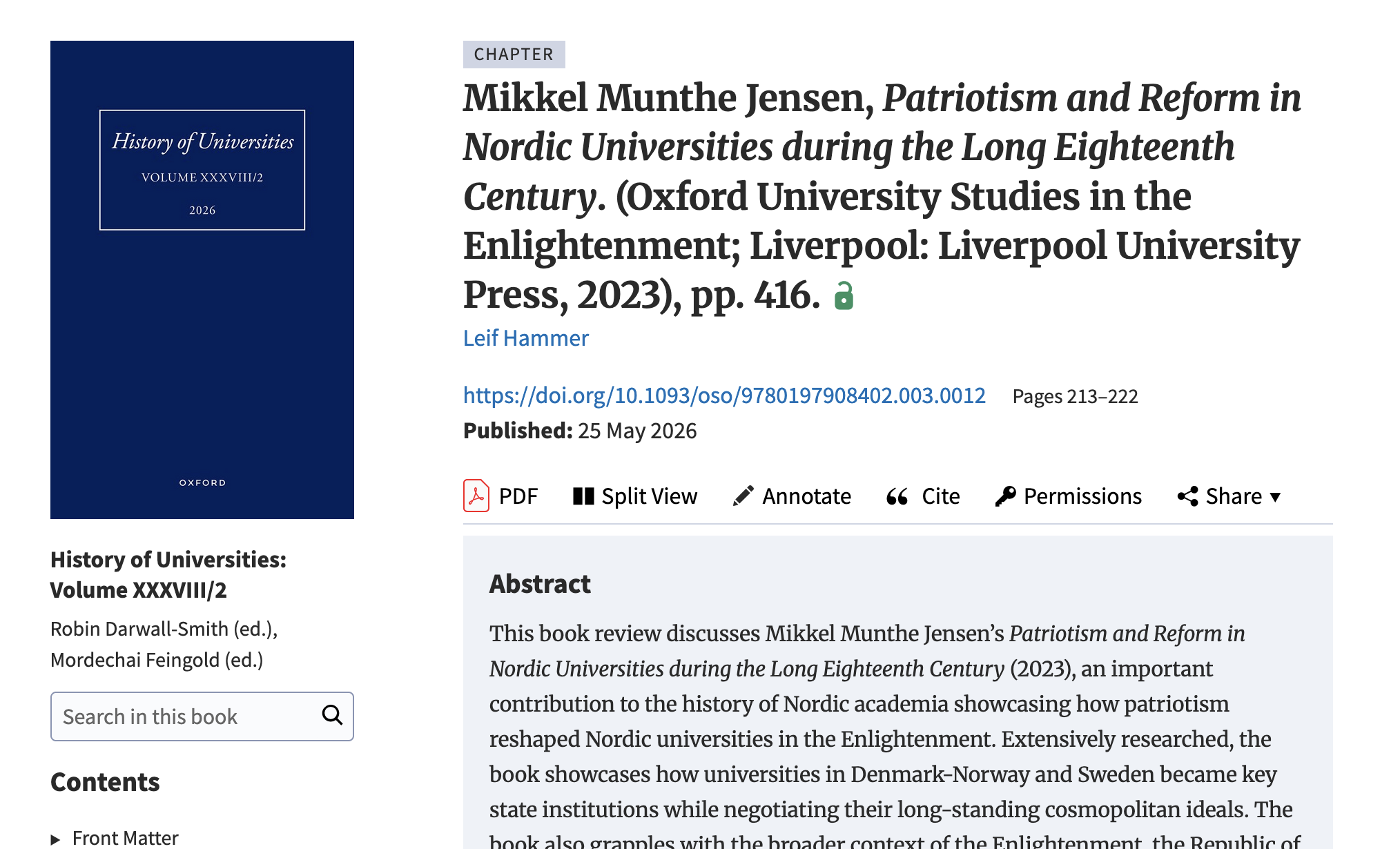
I have a book review out in History of Universities XXXVIII, no. 2 (2026).
The book I have reviewed is a monograph on Nordic universities in the long eighteenth century by Mikkel Munthe Jensen. It covers the changes universities in the Nordic region underwent in the long eighteenth century.
I started writing this review a good while ago, at the encouragement of Professor Mordechai Feingold (Caltech). But life, as it often does, came in the way and I didn’t find time to finish it. Later, Dr Robin Darwall-Smith (Oxford), who’s been very kind to me and helpful with my thesis research, asked me again after he also became editor of History of Universities. And this time, I finally sat down and finished my review.
The eighteenth century is generally considered a dull period for universities. Jensen shows that we should not disregard this period. Many interesting changes were happening within academia at the time. He also sheds light on a region of Europe often overlooked in university history: the Nordic region.
I won’t go into detail on that here. Not now. If you do have access through your university library, please read my book review, as well as all of the other reviews and articles in this fabulous volume of History of Universities, edited by Mordechai Feingold and Robin Darwall-Smith. And pick up Jensen’s book, too!
The full bibliographical info for the reviewed work is: Mikkel Munthe Jensen, Patriotism and Reform in Nordic Universities during the Long Eighteenth Century. (Oxford University Studies in the Enlightenment; Liverpool: Liverpool University Press, 2023), pp. 416.
My review of Johan Östling’s book Kunskapens stora hus: Huvudlinjer i universitetets historia (2024) was just published in the English Historical Review on the 3rd of December 2025. Östling’s is a wonderful and concise book on university history
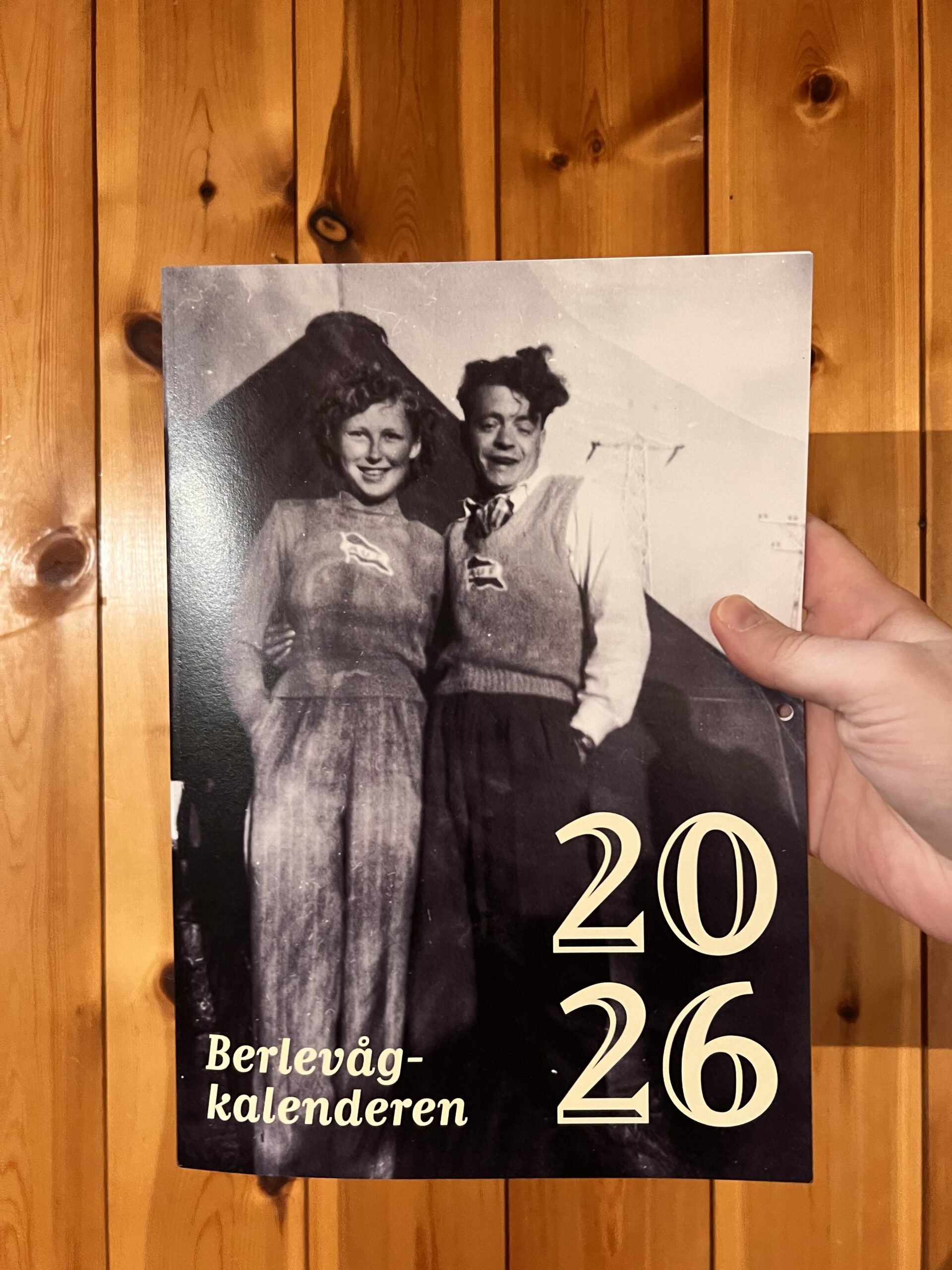
I have recently selected the photos and written the captions for the Berlevågkalenderen for 2026. This is a historical calendar published by the Berlevåg Harbour Museum. It’s goal, as I see it, is to disseminate different aspects of the local history. The calendar’s been published since the 90s (to my knowledge) and so it’s an honour to have been behind the entire production.
Selecting the images was a lengthy process. The photo archive database at my museum has some 5,000 objects —and that’s excluding the ones that have yet to be registered. Writing the captions involved using both the information already registered in the database (based on what informant’s could tell my predecessors about the photos) and retrieving new information from informants or by doing archival research. In my case, the digitised archive of Norwegian newspapers on the National Library’s website was invaluable.
Working on this has been a wonderful experience. It’s given us a chance to improve our database with new information and in some cases correcting erronous information —usually pertaining to dates. It’s also a wonderful way of getting glimpses into easily overlooked facets and pockets of local history, and to tie that history to both regional, national, and global ones.
The entries in the calendar range from a brutal murder in the 1890s to the opening of the public swimming pool in 1962; from an émigré to America in the early 1900s to a photo of my grandmother in a wintery landscape outside a house she bought, taken around 1990. Together the images tell stories of travel in its multiple meanings.
If anyone of my readers want to purchase the calendar for 190 NOK (around $19 or £15), plus shipping, feel free to email: post@berlevagmuseum.no.
Many thanks to Rudi Grafisk for the graphic design and Kraft Digitalprint for printing the calendars. Speaking to informants would have been impossible without the generous help of the local history society, who also looked through the proposed images and commented on them.
Going forwards —although I’m an early modernist at heart— I expect to be doing a lot more oral history. It’s exciting to be collecting data in this way. As a historian focused on a period where the people who lived during that period are long dead (or, who knows, perhaps there are some immortal vampires out there) you’re mostly confined to what the material in archives and museums can tell. There’s something refreshing about the concept of actually interviewing living, breathing people to collect their recollections —their lived experience. There’s also something terrifying about it.
I’ve done a few oral history interviews in the past, but with going into museum work, I’ll have to do a lot more of them. I face that prospect with trepidation and yet I think it’s very important. There are voices out there that will disappear, and these voices can fill in the gaps in missing histories that I think deserve to be preserved and circulated. We know that past people’s mental worlds were different. How we perceive ourselves and the world around us is temporal, spatial, and ephemeral. Smaller museums tend to focus on particular aspects of a place’s history and there’s nothing wrong with that. The reasons for that are many, no doubt Salem’s witch trials sell tickets. No doubt the industrialisation of Manchester is important to local people in Manchester because it informs their self-understanding in some way. Humans use history in various ways, to various effects, and for various reasons. History is important to us whether we realise it or not. For my hometown, the second world war —when it was occupied by the Nazis— is one of those key periods that will always stand out in the collective memory —and for the collective identity— of the place.
There is nothing wrong with keeping the memories and histories of the second world war alive at the museum. That is important, but we must not let it obfuscate other histories or let it lead us to overlook them. I think it is easy to do just that. One reason —a reason I often think of— is how we take some knowledges for granted. To give you one example, let’s say an American said to a non-American that they received a scary letter from the IRS. If the American offers no further explanation, they are assuming that the non-American knows what the IRS is or what it stands for. We all do this, in our daily lives. I bandy about abbreviations and facts about university history that presume that presume that the non-specialist already has a level of familiarity they may not have. Luckily, people ask when they do not know. I think the same goes for when we select what to save for posterity. This is not just true of doing oral history interviews, we see it all the time in the archives. There’s a discrepancy between what people thought was worth putting down on paper and what we —hundreds of years later— would really like to know. Some things are so blatantly obvious to us in the moment that we do not think to describe it to the outsider or even to assume that it would need explaining.
For oral history interviews this means teasing out what needs explaining. I think some important cases would be crafts (håndverk) and housework. If we look at preserved material culture in a small-town museum, we might know enough to label objects, but we don’t always know exactly how they were used, what they were used for, when they were used, who they were used by, or whether this was something everyone had or just a select few. For some objects, all these aspects may have been obvious then, but are they now? Look at the ‘save icon’, I’m old enough to know that that’s a floppy disk, but young people today can’t be expected to have seen a floppy disk or to know the what-when-who-how and if everybody with a computer had them or perhaps it was only used by corporations. If you’re not convinced, consider this. If I told you to write the word ‘hello’ in uppercase letters instead of lowercase letters (as I just did) do you know where ‘upper and lower case’ comes from? No? They come from printing. To assemble type for printing, printers had a set up with a case full of the uppercase versions of letters and another case with the lowercase letters; as you might guess, one case was above the other.
But it’s not just limited to cases like ‘how did fishermen use this particular hook and why did they stop’, it’s also related to understanding how people perceived the world around them. When my dad was sixteen years old, in 1960, he took a job on a ship transporting jet fuel around the world. He’s told me that was the thing to do back then, it was either that or going into fishing. There was no concept —in that time or place— of going off to university. When I was sixteen, the thing to do was to go to upper secondary school, I wouldn’t even know how to get a job on a ship like that if I wanted to. What we are dealing with here are different mental worlds; not only was the world actually different, but how one understood it was different. My dad’s perceptions have of course changed with time —indeed, the world’s changed massively seen he was born in the burnt down ruins of my hometown— and that is another issue with doing oral history. How we remember things are different from how they were. If we’re looking for unmediated, unfiltered factual data about the past we are out of luck unless we can corroborate that with other information. Memory is a difficult thing. That said, memory has an important place, and memories of how things were are —in and of themselves— crucial.
That brings me to the massive hurdle with oral history. As if deciding, as the ‘collector’, what is worth preserving isn’t pressuring enough, there is another difficulty. How do you get people to talk about the past and how do you make sure you can use it? What I mean is that it is difficult to know if you’re asking the right questions. Sure, you might get someone to talk about what their household looked like in the 1960s in a small town but are you asking detailed enough questions. Or will you sit there months later realising you forgot to ask how many rooms were in the house, whether they shared with another family. Or perhaps you realise they might not have been representative because they were the priest’s daughter and where socio-economically likely better off than most other families. I don’t expect there to be a right answer to that, I expect oral history to be an art; by doing it you learn to ask the right questions to the right level of detail.
The second issue is how do make sure you can use your oral history interviews? You need the participant’s consent for you to not only record the interview but to store it and use it for historical scholarship —be that museum exhibitions or publications. What I have found is that older people are worried about giving you that consent. They don’t want to be misconstrued. They feel a pressure to get things right and are worried that they misremember facts and that others might get mad with them for having ‘lied’ (in their view). There’s no easy solution to this other than to try and explain that even if they’re factually wrong about something, how they perceive or remember the past is more important than an error. More importantly, without their recollections, lived experience could go lost. Especially lived experience that I think is equally as important to preserve as the lived experiences of the second world war.
And that is why, although I’m terrified and see many difficulties with doing oral history, I think oral history is worth doing.
This blog post also appeared on my Substack. To get email alerts when I write something, join my Substack here.
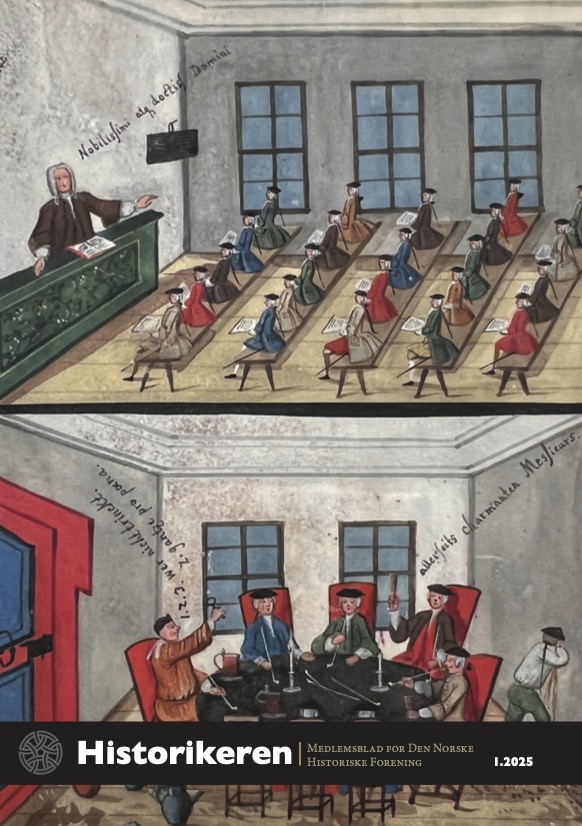
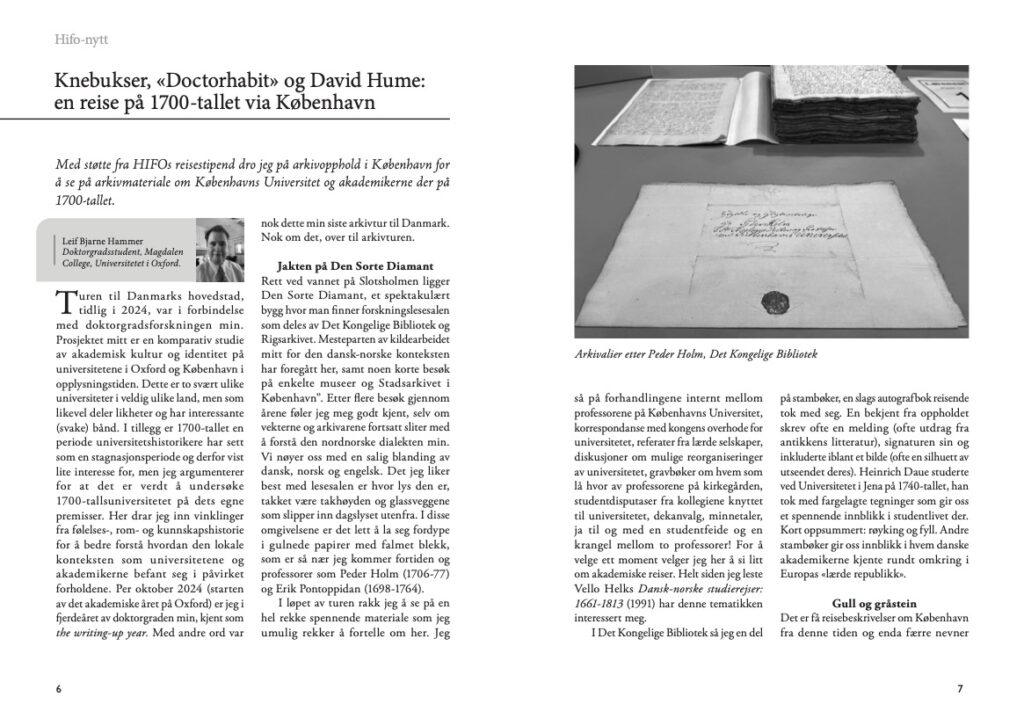
I have a new magazine article out, all about my archival visit to Denmark in 2024. The article is published in the Norwegian Historical Association’s members’ magazine Historikeren 1 (2025).
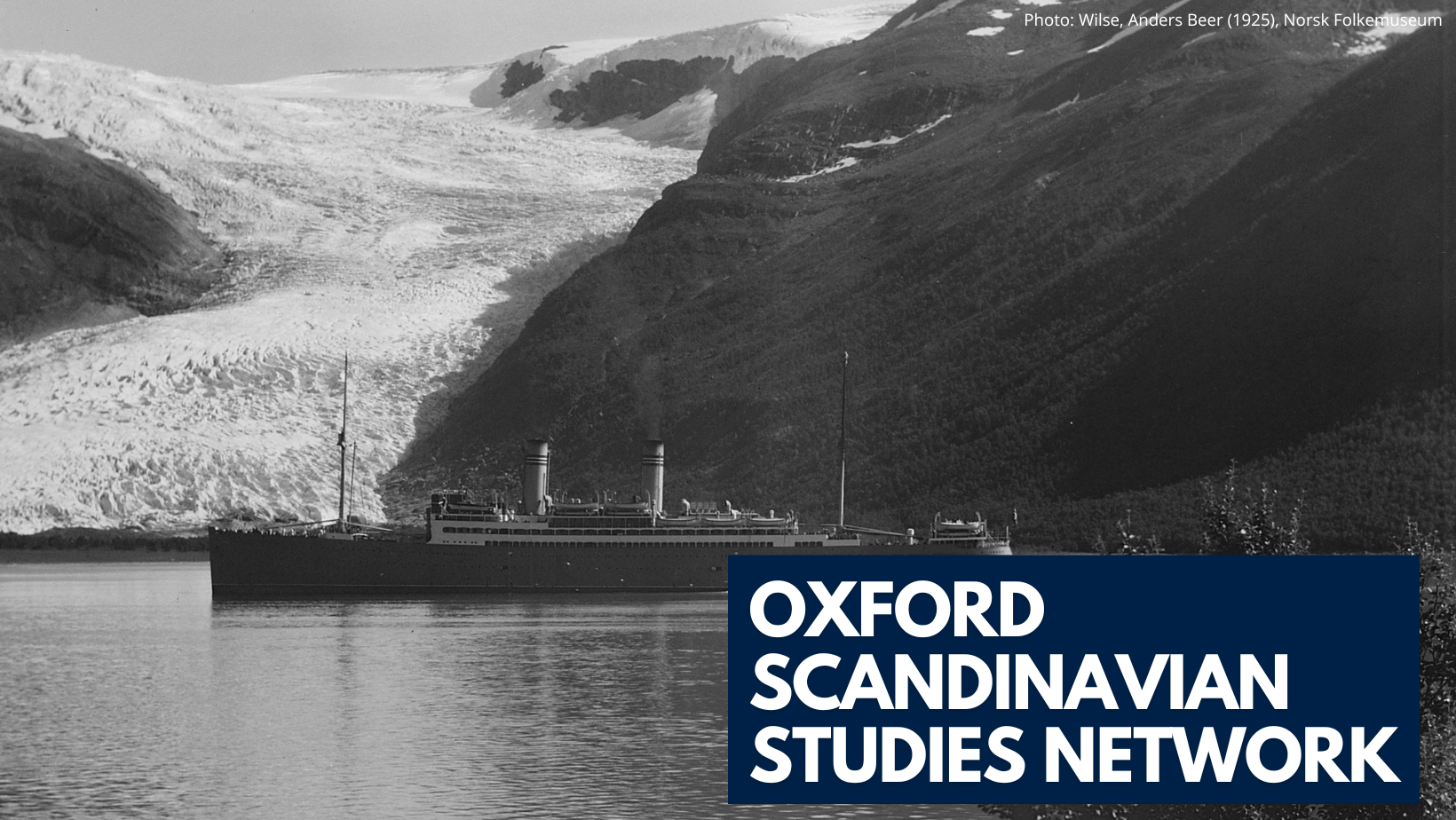
This Friday, at 10am (GMT) online, I’ll be chairing a seminar on ‘Environmental History’ for the Oxford Scandinavian Studies Network. We have two fantastic speakers ligned up:
Wanda Marcussen (Oslo): Violent Storms and Disappearing Fish: Climate Anomalies and the Coastal Landscape as Factors in the North Norwegian Witch Trials of the 17th Century
Christian Drury (Durham): Seeing Ice, Writing Ice: Glacier Tourism in Norway, 1850-1940
The Oxford Scandinavian Studies Network is a TORCH (The Oxford Research Centre in the Humanities) Student Network at the University of Oxford. I am one of the co-founders and chairs. You can read more about us here.
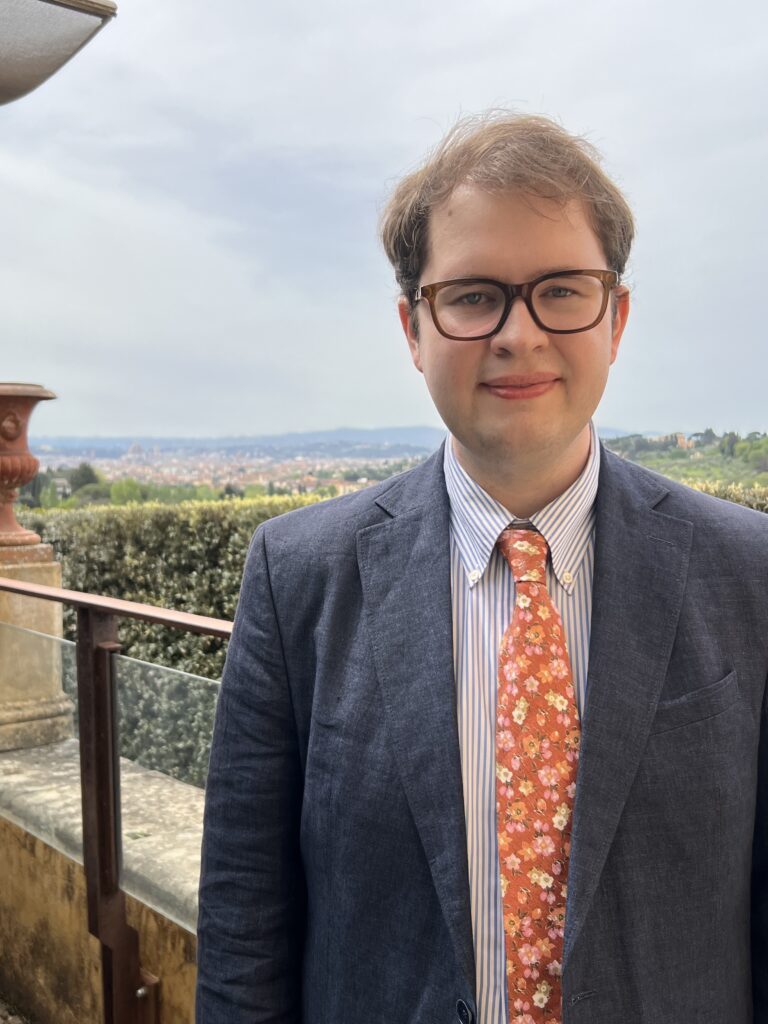
From a conference at the EUI in Florence, Italy. Photo: Aaron Larsen.
Welcome to my website! I am a historian interested in early modern (and particularly eighteenth-century) Britian and Scandinavia.
I am currently writing-up my doctoral thesis at the University of Oxford. My thesis is a comparative study of the universities of Oxford and Copenhagen in the eighteenth century.
That said, I also work on the modern history of Norway.