This January, I attended a wonderful university history conference in Limerick, Ireland. Organised by Professor Richard Kirwan and Dr Wouter Kreuze at the University of Limerick, along with a team of graduate students. The conference concerned university courts and jurisdiction in early modern Europe.
The conference came out of Kirwan’s Malcontents project, which focuses on:
“the nature and experience of marginality in the universities of the Holy Roman Empire in the early modern period. The project explores how academic communities and ruling authorities defined and responded to deviance in university contexts. The project themes are investigated across three work packages on religious non-conformity, social delinquency in the professoriate, and student ritual respectively. The project thus interrogates the importance of the identification and suppression of deviance in the substantiation of order in the early modern university and beyond.” (from the project website).
The project’s funded by Taighde Éireann – Research Ireland.
Attending the conference was a great pleasure. It’s not every day that you get to meet fellow historians who specialise in university history. I am also happy that my paper “Nocturnal Activities: Contesting University Discipline in Eighteenth Century Oxford and Copenhagen” (and yes, that is a nod to Indiana Jones and the Temple of Doom) was very well-received!
University jurisdiction
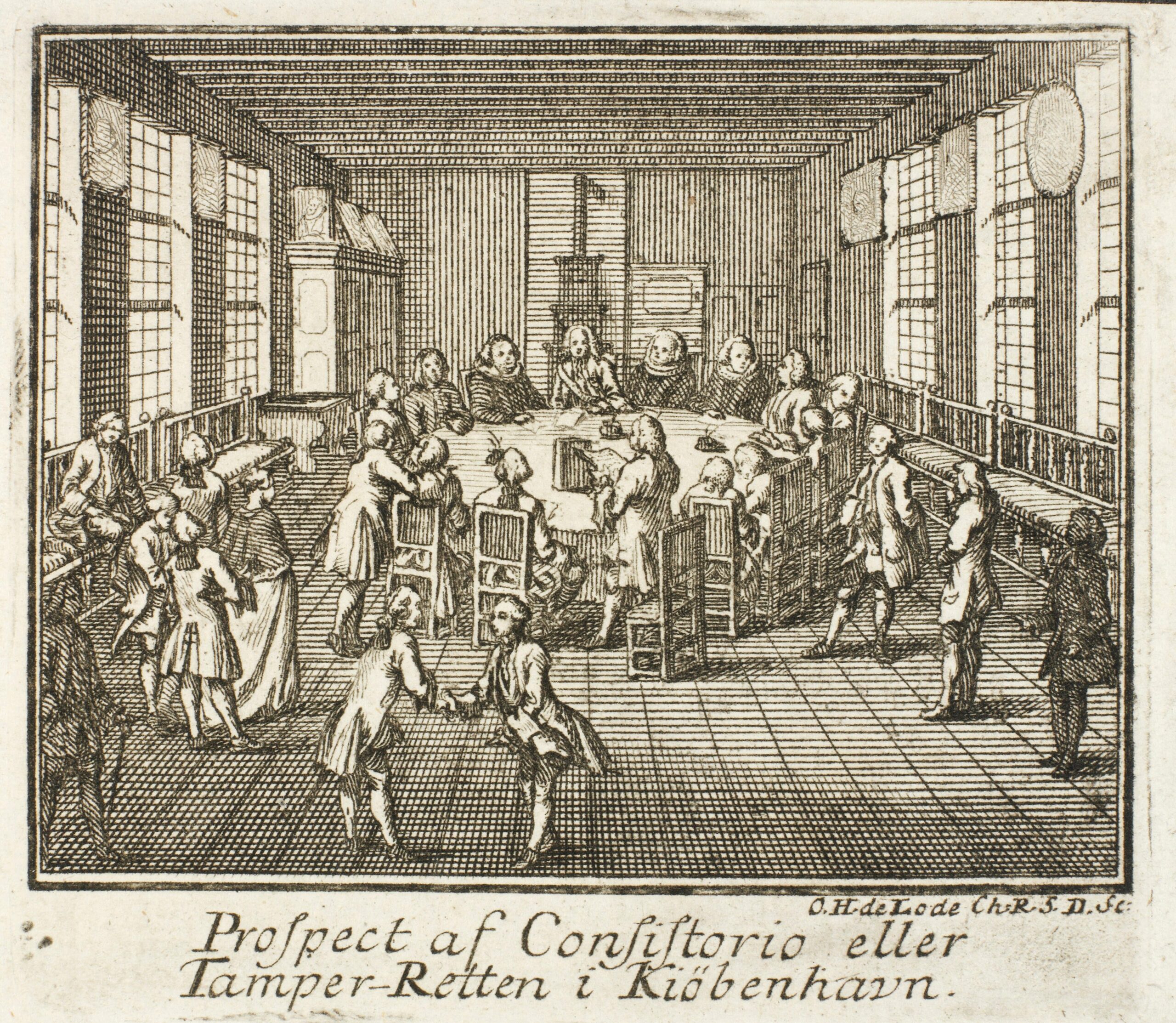
We modern-day people are used to a single unified jurisdiction, but that was not the case in early modern Europe. The jurisdiction you came under depended heavily on who you were (social position, profession, geographical position, confession, etc.) as well as the nature of your crime. Most early modern universities had jurisdiction over their own members, their academic citizens. This citizenry included not only students and professors but also university book printers, officers, and servants, among others. If you broke the rules—depending on the severity of your rule-breaking—you might find yourself in the university court. Who this court consisted of and where it met varied from university to university, and in some places, other authorities were involved (such as external clergy, town representatives, and so on). For the most part, the university court consisted of the professoriate and the university’s head.
Some highlights
In two days, we navigated the complex histories of university courts, legal proceedings, disciplinary regimes, student deviance, and the difficulties of academic households and protecting (or trying to) your own. The following is merely a few highlights: Kreuze gave an important paper on document typologies in early modern German university courts.
Ken Ird (Tartu) gave an interesting paper on the University of Tartu, which changed hands from being a European university founded by Gustav II Adolf of Sweden in 1632 to becoming part of tsarist Russia. It was the only traditional European (German) university in the Russian Empire. Ird also showed us the old student prison in Tartu.
Colin Donnelly (Oxford) discussed Gottlieb Spitzel’s (a seventeenth-century Protestant theologian and polymath in Augsburg) views on morality and knowledge. His talk centred on academic virtue and vice in the context of religious confessionalism.
Alan Ross (Vienna) spoke about ‘school courts’ and disciplinary regimes in the Holy Roman Empire. Ross brought up a case of pupils from a Protestant grammar school getting into brawls with the Catholic and Jesuit pupils. There was also a case of pupils crucifying a frog, burying the frog outside a professor’s house, then digging the frog up, and burying it in the Catholic graveyard.
Kirwan discussed Koenigsberg professor Caspar Perband and the events of 1592–1596, when Perband was stripped of his academic title and post, reinstated by ducal order, then dismissed from the university and exiled from Prussia. Perband famously stabbed one of his students, and while his colleagues were prepared to excuse him, the authorities grew concerned with his behaviour (he was also a poor administrator and a drunkard).
Mari Välimäki (Turku) presented a paper on academic families in early modern Sweden, focusing on a case of a student’s fornication with a servant girl. The student was the son of a university professor. Family ties and biases saw many professors excuse themselves from overseeing this court case.
I also really enjoyed Professor Dr Marian Füssel’s (Georg-August-Universität Göttingen) keynote on student deviant practices in the Holy Roman Empire. And I was happy to finally meet Professor Kirwan in person (having previously corresponded via email). There are not that many historians focused on Nordic universities, therefore I am especially happy to have gotten to know Dr Mari Välimäki.
This post is an excerpt from my Substack. To read the full blog post, go to leifhammer.substack.com